Written by Dr. Dawson, DPM, FACFAS, Foot and Ankle Surgeon · Last updated November 2026
TL;DR: A Lisfranc injury damages the joints in the middle of the foot, where the arch locks together. Some heal in a cast with no weight on the foot for 6 weeks. When the joints shift out of line or the bones break into the joints, surgery gives the best shot at a foot that works well long term. Surgery either holds the joints with plates and screws while they heal, or fuses the damaged joints solid. Recovery runs about 3 months to a regular shoe. The biggest long term risk is arthritis in the midfoot, and getting the joints lined up right is the best protection against it.
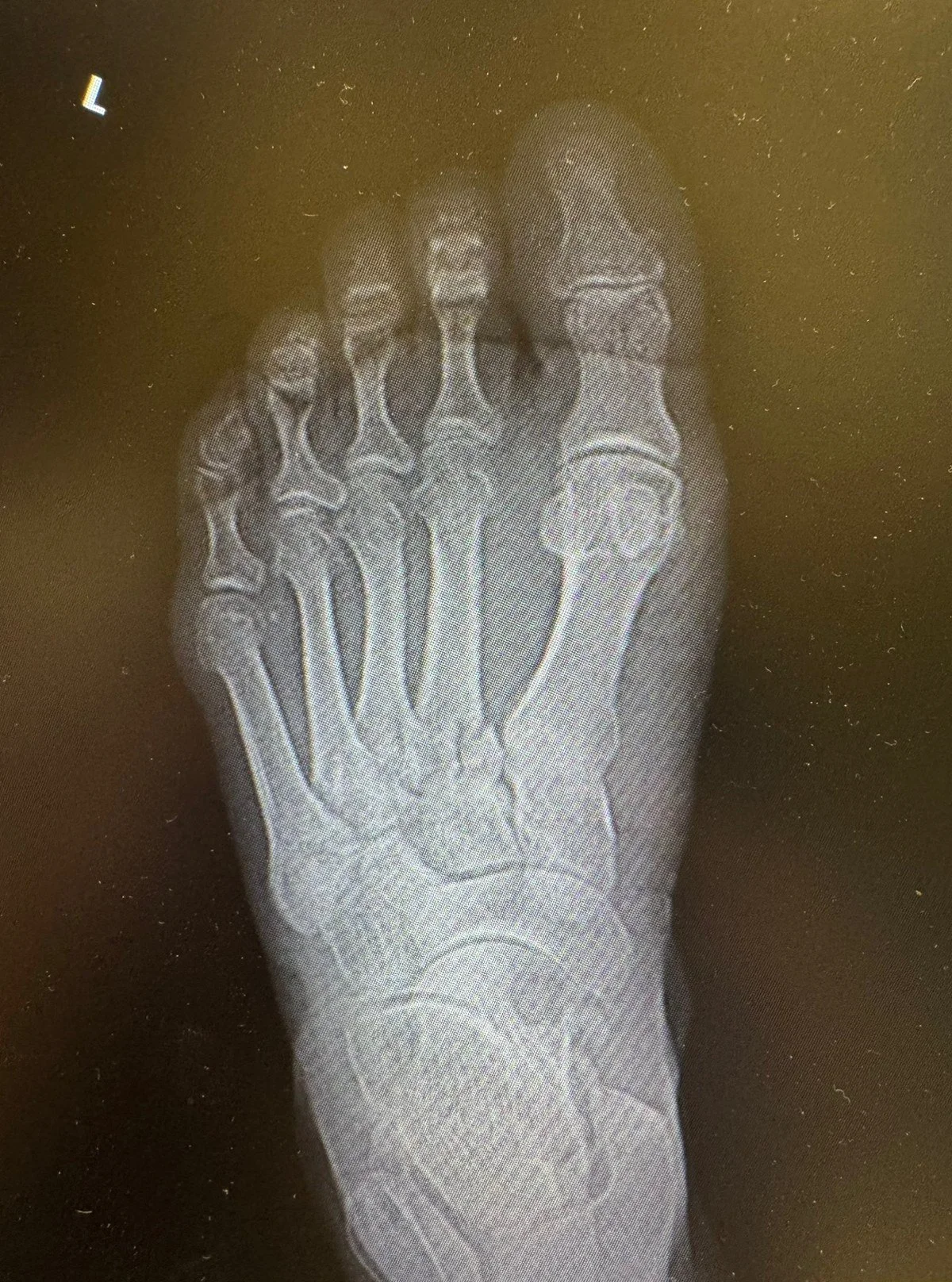
A Lisfranc injury on X ray. The midfoot joints have shifted out of line.
What a Lisfranc injury actually is
The Lisfranc joint is not one joint. It is the row of joints in the middle of your foot where the long metatarsal bones meet the smaller midfoot bones. The base of the second metatarsal sits recessed between the midfoot bones, wedged in like the keystone at the top of a stone arch. That wedge is what locks the arch together. Every step you take pushes through it.
A Lisfranc injury is damage to that joint row. At the mild end it is a sprain of the ligaments that hold the wedge in place. At the severe end the bones fracture, the joints dislocate, and the keystone pops out of the arch. Both ends of that range carry the same name, which is why the injury confuses people. A Lisfranc sprain and a Lisfranc fracture-dislocation are very different problems with very different recoveries.
These injuries are uncommon. The classic teaching puts them at about 0.2 percent of all fractures, roughly 1 person in 55,000 a year.1 A newer study that counted injuries on CT scans found them more often than that, and found most came from low energy trauma, the kind of twist or fall that does not look like much.2
How it happens
There are two roads in.
High energy. Car accidents, falls from a height, a crush injury. These tend to fracture the bones and dislocate the joints.
Low energy. A twist with the foot planted. Stepping off a curb wrong. A fall from something low, like a step stool or a table. An athlete landing on the top of a pointed foot with someone else's weight on the heel. These tend to tear the ligaments, and they are the ones that get missed, because the foot can look almost normal from the outside.
The films in this guide are from a real case in my practice. A fall from a table while changing lightbulbs. The fracture crushed the base of the second metatarsal, the keystone itself. That case is written up in full on the Case Reviews page.
The symptoms that matter
- Pain and swelling across the middle of the foot
- Bruising on the sole of the foot. This one is a flag. A bruise on the bottom of the arch after a foot injury points hard at the midfoot joints.
- Pain when you stand or try to push off
- A feeling that the foot gives way or spreads under you
Up to 20 percent of these injuries are missed or misdiagnosed at the first visit.1 They get called a sprain, and a sprain gets told to walk it off. Walking on an unstable Lisfranc injury grinds the joints and makes the end result worse. Delayed diagnosis is one of the few things the research agrees worsens the outcome.3 If your midfoot still hurts a week after a twist or a fall, and especially if the sole of your foot bruised, get it looked at again and ask about the midfoot by name.
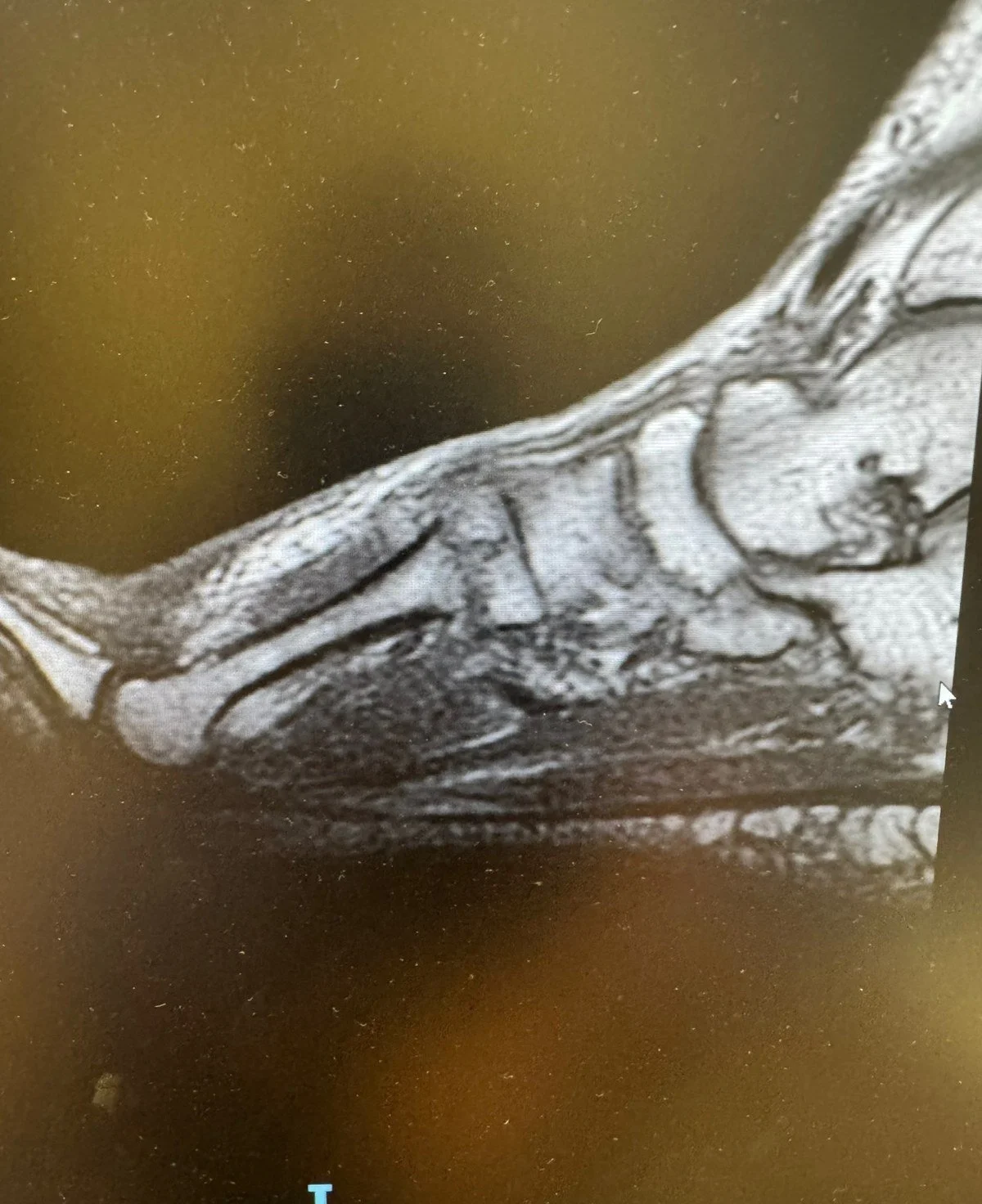
An MRI shows the joint and ligament damage that plain X rays can understate.
How it gets diagnosed
Start with X rays taken while you stand on the foot. Weight bearing matters. A joint that sits in line while you lie on a table can gap open the moment you stand on it. The finding that matters is a shift or a gap at the base of the second metatarsal, the keystone joint.
When the X rays look near normal and the exam does not, the next step is a CT scan to look for small fractures and joint shifts, or an MRI to look at the ligaments themselves. A subtle Lisfranc injury is a diagnosis you make by refusing to be reassured by a normal looking first X ray.
Treatment without surgery
Some Lisfranc injuries are stable. The joints have not shifted, the ligaments are partly torn but holding, and the arch lines up under your weight. Those heal without surgery.
The treatment is a cast or a boot with no weight on the foot at all for 6 weeks, then a gradual return to walking.3 No weight means none. The keystone cannot heal while it is being pried at with every step. After the 6 weeks, X rays under weight confirm the joints held their position before you load the foot again.
Treatment with surgery
Surgery is for the unstable injury. The joints have shifted, the bones are broken into the joints, or the arch no longer lines up. Leaving that to heal crooked loads the wrong parts of the joint with every step, and arthritis follows. In the largest older series of fixed Lisfranc injuries, a quarter of patients had arthritis in the joints within about 4 years, and the single biggest predictor of a good result was getting the joints lined up exactly.4
There are two operations, and choosing between them is the real decision.
Fix it and keep the joints (ORIF). The surgeon lines the joints back up and holds them with plates and screws while the bones and ligaments heal. The joints stay joints. Some of the hardware crosses joints that are supposed to move a little, so plates and screws often come out in a second, smaller surgery once everything has healed.
Fuse the damaged joints (primary arthrodesis). The surgeon lines the joints up and fuses them solid, so the bones grow together. This sounds drastic. In the midfoot it usually is not. Those joints only move a few degrees in a healthy foot, and a joint with its cartilage crushed will never be a good joint again. Fusing it trades a small amount of motion for a stable, lined up, painless arch.
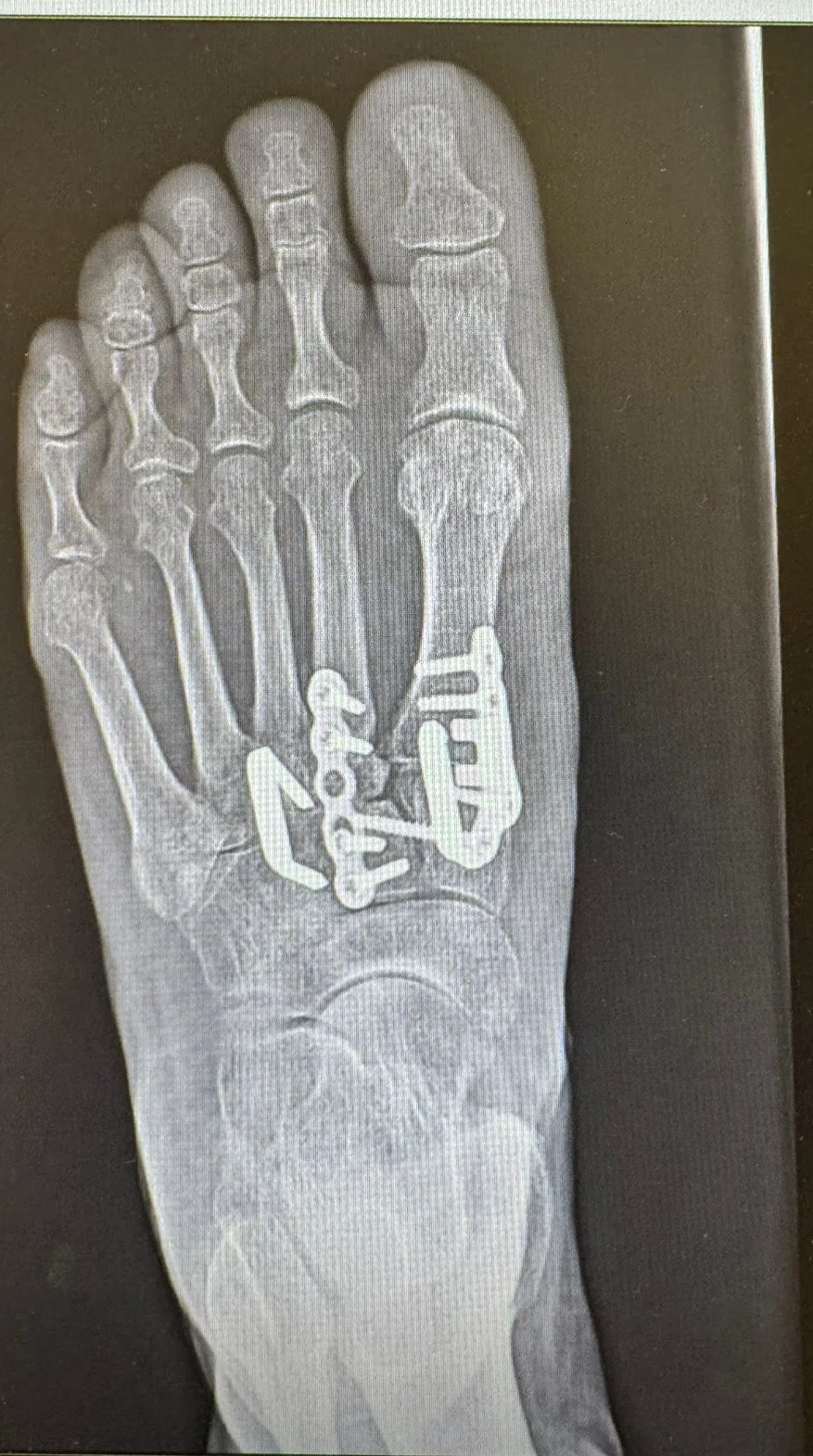
After surgery. The damaged joints fused in line with plates and a screw.
What the research says about fixing vs fusing
This is one of the better studied questions in foot surgery, and the answer depends on which injury you have.
For injuries where the ligaments tore but the bones did not break, a randomized trial compared the two operations head to head. The fusion group scored higher on foot function scores at 2 years and rated themselves back to 92 percent of their preinjury activity, against 65 percent for the fix it group. Five of the 20 fixed patients went on to need a fusion anyway.5
For fracture-dislocations, where bone is broken as well as ligaments torn, a second randomized trial found the two groups ended up with similar function and similar satisfaction. The clear difference was second surgeries. About 4 out of 5 fixed patients had another operation, against about 1 in 6 fused patients, mostly to remove hardware that crossed the joints.6
Pooled across the studies, the pattern holds. Arthritis shows up in about 17 percent of fixed midfeet against about 3 percent of fused ones, unplanned second surgeries run higher after fixing, and return to preinjury activity favors fusion, roughly 79 percent against 66 percent. The honest caveat, which the reviewers themselves raise, is that the evidence is not strong enough to make fusion the answer for every injury, and nobody yet knows what a fused midfoot does to the joints next to it over 30 years in a young active patient.7,8
My working rule follows from the injury, not from a preference. If the joint surfaces survived, fix it and keep the joint. If the surfaces are crushed, fuse it. A destroyed joint does not heal back into a smooth joint, and fixing it just schedules the fusion for later, after a year of hurting.
Recovery, week by week
Protocols vary by surgeon and by injury. This is the pattern I use, and it matches how most published series run their recoveries.3
| When | What happens |
|---|---|
| Weeks 0 to 6 | No weight on the foot. Splint, then a cast or boot. Crutches, a knee scooter, or a walker. Foot up when you can, swelling is the enemy. |
| Weeks 6 to 10 | Walking in a boot, weight as tolerated. The boot protects the midfoot while the bones finish knitting. |
| Weeks 10 to 12 | Out of the boot and into a stiff, supportive shoe. |
| Months 3 to 6 | Strength and balance work. Swelling fades slowly, the midfoot is often the last place to calm down. |
| Sports | Return runs anywhere from about 2 to 8 months depending on the injury and the sport. |
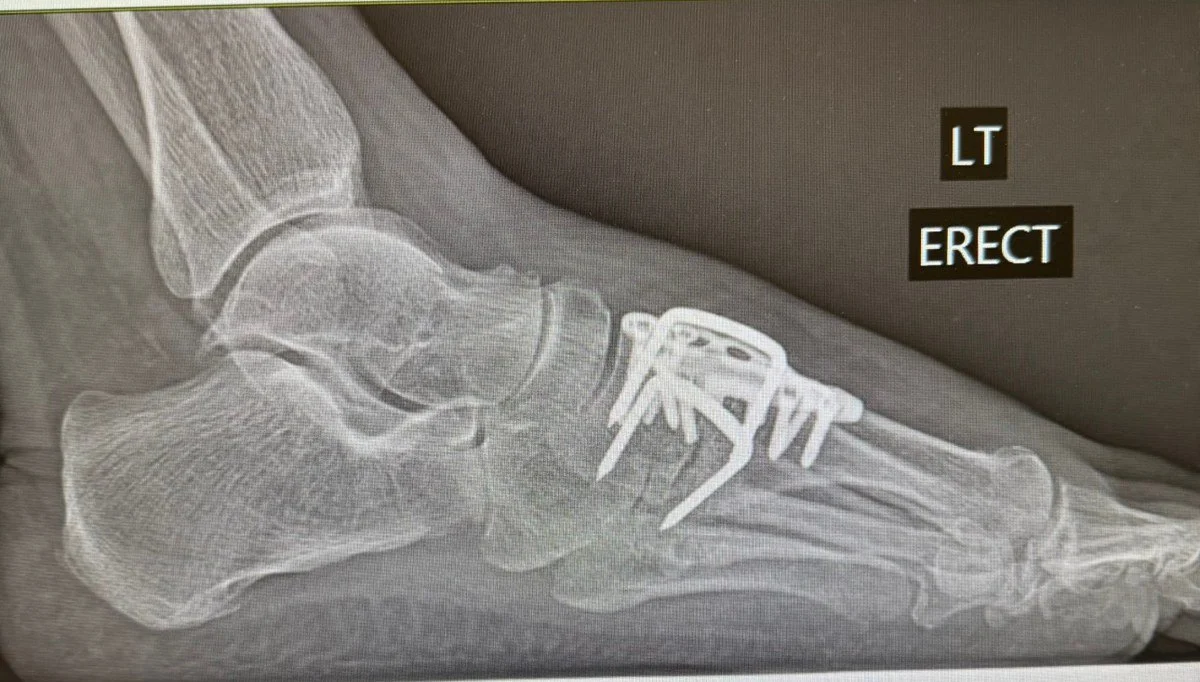
Twelve weeks out, standing on it. Arch restored, hardware in place.
Across the studies of athletes with this injury, about 93 to 94 percent got back to some level of sport, and roughly three quarters to nine tenths got all the way back to their preinjury level.9 The spread is wide because the injuries are wide. A ligament sprain in a runner and a fracture-dislocation in a lineman share a name and not much else.
If you had the fix it operation, plan on a likely second surgery to remove hardware. That is a known cost of keeping the joints, not a complication.
The long term picture
The main long term risk is arthritis in the midfoot joints. It is the reason the alignment at surgery matters so much, and the reason a missed injury does so much damage. In the fixed group of the largest series, arthritis developed in 25 percent, and half of those patients eventually had the joints fused.4 A fused midfoot that was lined up well tends to stay quiet. A midfoot that healed crooked tends not to.
Stiffness after a midfoot fusion is real but small, because the joints gave up very little motion to begin with. Most people walk, hike, and work on a fused midfoot without thinking about it. Running and cutting sports ask more of it, and that tradeoff belongs in the conversation before surgery, not after.
Products that earn their place here
Recovery from this injury is mostly a boot, time, and patience. Two things help.
- CAM Walker Boot. The boot you will live in from week 6. Fit matters more than features.
- EvenUp Walking Boot Leveler. Worn on the other shoe so your hips and back are not paying for the boot's height.
Frequently asked questions
Can a Lisfranc injury heal without surgery?
Yes, if it is stable. Stable means the joints have not shifted and the arch lines up when you stand. Stable injuries heal in a cast or boot with no weight on the foot for 6 weeks. Unstable injuries do not heal straight on their own, and those are the ones that need surgery.
How long until I can walk normally?
Most people are off the foot completely for 6 weeks, walking in a boot until about 10 weeks, and in a regular shoe around 12 weeks. Swelling and stiffness keep improving for 6 months or more after that.
Will I need another surgery?
If your joints were fixed with plates and screws, probably. Hardware that crosses the midfoot joints usually comes out once the injury has healed, and in one trial about 4 out of 5 fixed patients had a second operation. If your joints were fused, the hardware usually stays unless it bothers you.
Will I get arthritis from this?
It is the main long term risk. In the largest series of fixed injuries, 25 percent developed arthritis within about 4 years. The risk is lower when the joints are lined up exactly, and lower still in the studies of patients whose damaged joints were fused at the first surgery.
Is a fusion as bad as it sounds?
In the midfoot, usually not. These joints move only a few degrees in a healthy foot. A fusion trades that small motion for a stable arch that does not hurt. Most people walk and work on it without noticing. The tradeoff matters more for runners and cutting sport athletes.
When can I play sports again?
Published results run from about 2 to 8 months. About 93 to 94 percent of athletes in the studies returned to some level of sport, and most of those reached their preinjury level. Your injury pattern and your sport decide where in that range you land.
References
- Desmond EA, Chou LB. Current concepts review: Lisfranc injuries. Foot & Ankle International. 2006;27(8):653-660. DOI: 10.1177/107110070602700819. PMID: 16919225.
- Ponkilainen VT, Laine HJ, Mäenpää HM, Mattila VM, Haapasalo HH. Incidence and characteristics of midfoot injuries. Foot & Ankle International. 2019;40(1):105-112. DOI: 10.1177/1071100718799741. PMID: 30269512.
- Grewal US, Onubogu K, Southgate C, Dhinsa BS. Lisfranc injury: a review and simplified treatment algorithm. The Foot. 2020;45:101719. DOI: 10.1016/j.foot.2020.101719. PMID: 33038662.
- Kuo RS, Tejwani NC, DiGiovanni CW, Holt SK, Benirschke SK, Hansen ST Jr, Sangeorzan BJ. Outcome after open reduction and internal fixation of Lisfranc joint injuries. The Journal of Bone and Joint Surgery. American Volume. 2000;82(11):1609-1618. DOI: 10.2106/00004623-200011000-00015. PMID: 11097452.
- Ly TV, Coetzee JC. Treatment of primarily ligamentous Lisfranc joint injuries: primary arthrodesis compared with open reduction and internal fixation. A prospective, randomized study. The Journal of Bone and Joint Surgery. American Volume. 2006;88(3):514-520. DOI: 10.2106/JBJS.E.00228. PMID: 16510816.
- Henning JA, Jones CB, Sietsema DL, Bohay DR, Anderson JG. Open reduction internal fixation versus primary arthrodesis for Lisfranc injuries: a prospective randomized study. Foot & Ankle International. 2009;30(10):913-922. DOI: 10.3113/FAI.2009.0913. PMID: 19796583.
- O'Connor KP, Tackett LB, Riehl JT. Primary arthrodesis versus open reduction internal fixation for acute Lisfranc injuries: a systematic review and meta-analysis. Archives of Orthopaedic and Trauma Surgery. 2025;145(1):49. DOI: 10.1007/s00402-024-05700-z. PMID: 39680239.
- Magill HHP, Hajibandeh S, Bennett J, Campbell N, Mehta J. Open Reduction and Internal Fixation Versus Primary Arthrodesis for the Treatment of Acute Lisfranc Injuries: A Systematic Review and Meta-analysis. The Journal of Foot and Ankle Surgery. 2019;58(2):328-332. DOI: 10.1053/j.jfas.2018.08.061. PMID: 30850102.
- ter Laak Bolk CS, Dahmen J, Lambers KTA, Blankevoort L, Kerkhoffs GMMJ. Adequate return to sports and sports activities after treatment of Lisfranc injury: a meta-analysis. Journal of ISAKOS. 2021;6(4):212-219. DOI: 10.1136/jisakos-2020-000477. PMID: 34272297.