
Written by Dr. Dawson, DPM, FACFAS, Foot and Ankle Surgeon · Last updated November 2026
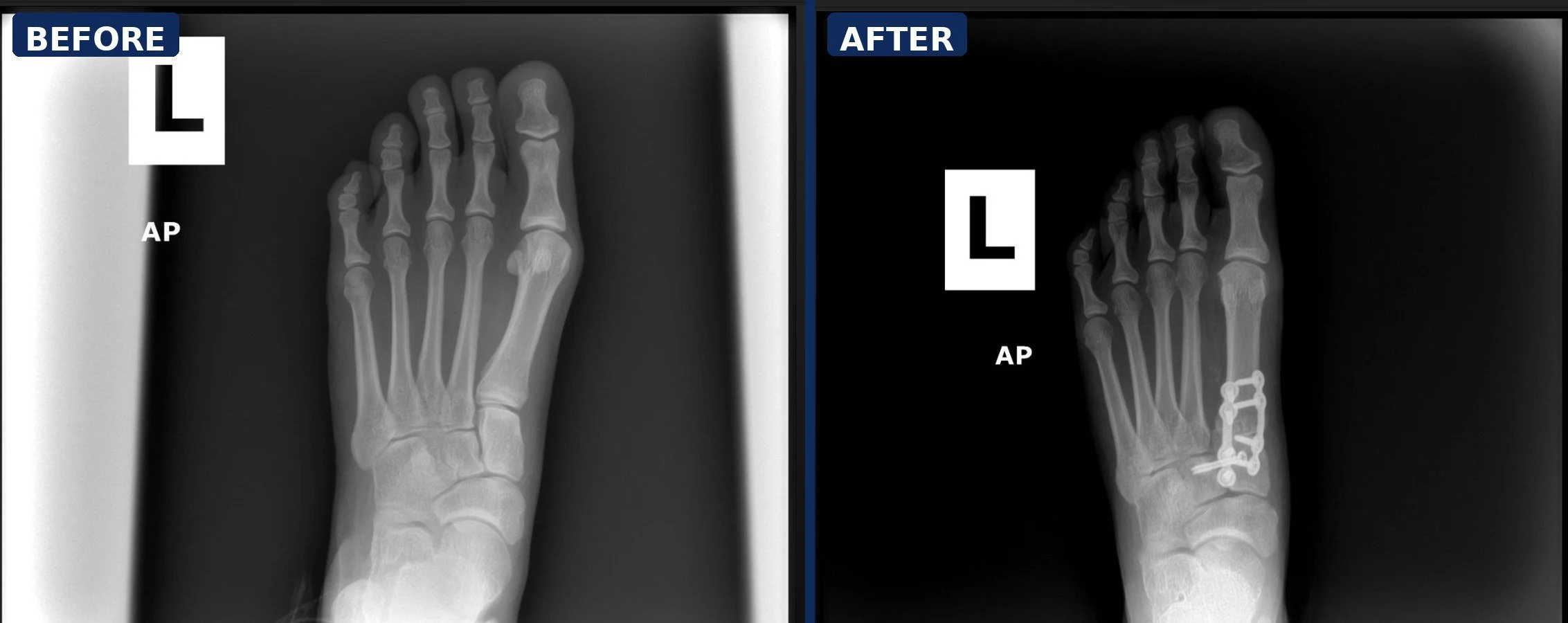
Before and after. Same foot, one fusion at the base of the metatarsal.
The condition. A bunion is not a bump that grows. It is the first metatarsal drifting away from the second toe while the big toe leans the other way. When the angle between the metatarsals is wide and the sesamoids have slid out from under the head, the deformity is being driven from the base of the bone.
The surgery. A Lapidus corrects the bunion at that base instead of only trimming the bump. The joint where the first metatarsal meets the midfoot is opened and the cartilage is taken off both sides. The metatarsal is swung back toward the second toe to close the wide angle, and turned so the sesamoids come back under the head where they belong. With the bone held straight, the joint is fixed with a plate and screws, and one extra screw runs between the bases of the first and second metatarsals to keep the correction from drifting. The two bones then heal into one solid piece, which is what the after film shows.
Before and after. Before, the metatarsal sits wide and the toe leans across. After, the angle is closed, the sesamoids sit back under the metatarsal head, and the fusion has consolidated around the plate and screws, with the hardware intact.
The full guide to bunion causes, shoes, pads, and every treatment option, surgical and not, is here: Bunions: The Complete Treatment Guide
