
Written by Dr. Dawson, DPM, FACFAS, Foot and Ankle Surgeon · Last updated November 2026
Your feet carry you through every step of your life. Each one is built from 26 bones, 33 joints, and more than 100 muscles, tendons, and ligaments. Your two feet hold about a quarter of all the bones in your body. When something that complex hurts, it deserves a doctor who trained on nothing else.
The short version
- A podiatrist is a doctor and surgeon with seven years of training after college. School covers the core medical sciences, then focuses on the foot and ankle, and residency is built around the foot and ankle.
- Podiatrists diagnose, prescribe, and operate, in clinics, hospitals, and surgery centers.
- When podiatry joins the care team, major amputations fall by more than half.
- The need for foot and ankle care keeps growing, as people age and diabetes rates rise.
Seven years on one body part
Podiatry is a medical and surgical specialty, and the training matches that. A podiatrist earns a Doctor of Podiatric Medicine degree, the DPM, after four years of podiatric medical school. Getting in runs through the same front door as the rest of medicine. Applicants bring a degree, the required science classes, and most take the MCAT. The early years cover anatomy, physiology, pharmacology, and pathology, the core sciences every medical student learns. From there the focus narrows to the foot, ankle, and lower leg, and it stays there.
School is the first four years. Each podiatrist then does a hospital residency in podiatric medicine and surgery. Since 2013, each program in the country has run at least three years.1 Residents care for hospital patients, take call, and operate. The surgical programs, called PMSR/RRA, add deep training in reconstructive rearfoot and ankle surgery on top of that.
Add it up and a podiatrist trains for seven years after college. That is the same total training time as internal medicine, family medicine, and pediatrics. The focus is the difference. School narrows to the foot and ankle, and residency is built around it.
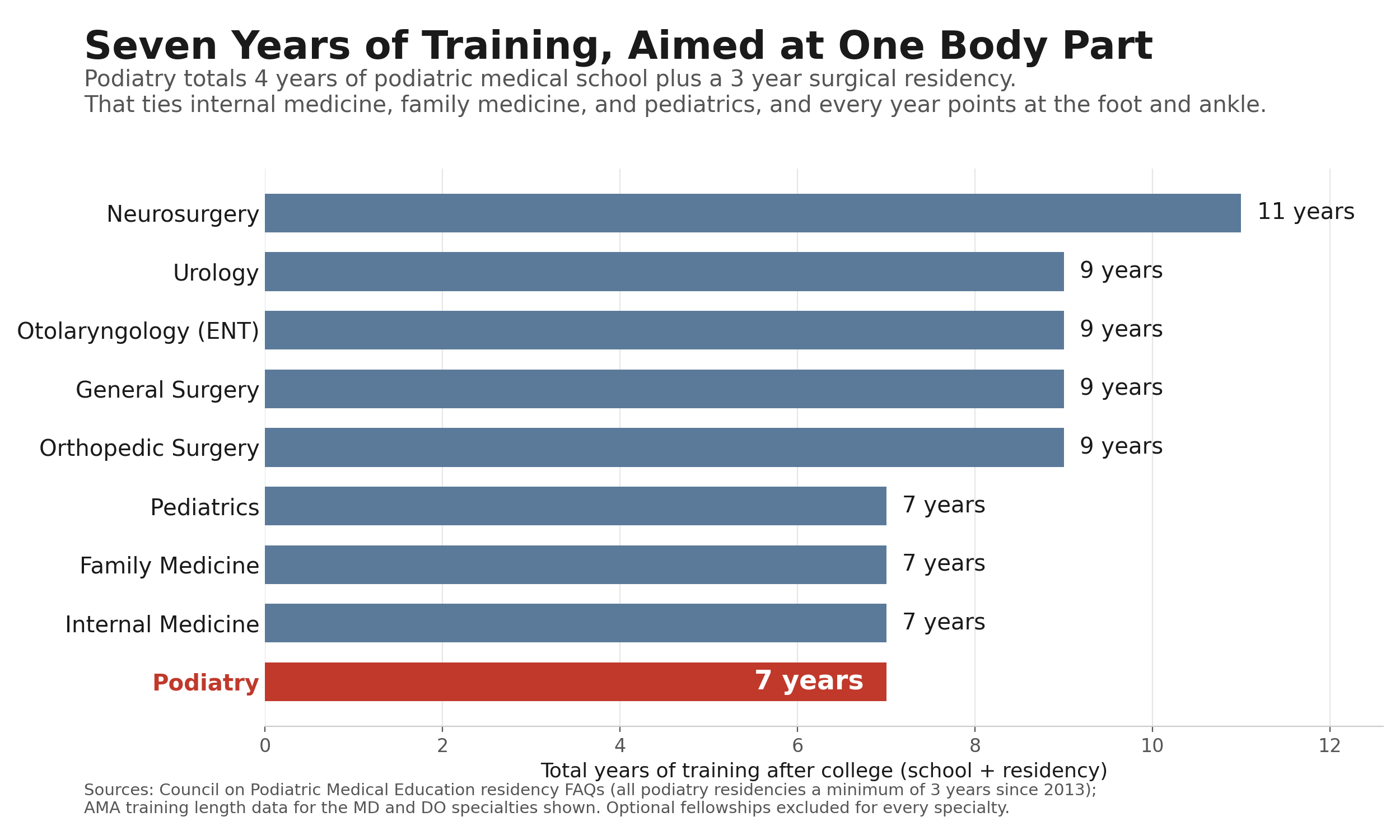
Total training after college, by specialty. Podiatry's path ends with three residency years dedicated to the foot and ankle.1
Foot and ankle surgeons arrive by two paths, and the specialty is stronger for having both. An orthopedic surgeon does four years of medical school and five years of orthopedic residency across the whole skeleton. Then comes a fellowship year focused on the foot and ankle.2 A podiatrist takes the other path. Four years of podiatric medical school, then a three year podiatry residency, built around the foot and ankle from the first day.1 That residency also rotates through medicine, general surgery, and related services. The center of the training stays the foot and ankle. The podiatry path reaches the specialty through residency itself. The orthopedic path reaches it through fellowship. Both end at the same place, a surgeon whose practice is the foot and ankle, and the two work side by side in hospitals and practices across the country. Many podiatrists add an optional fellowship year on top of the three residency years. That year can focus on reconstructive foot and ankle surgery, limb salvage, or wound care.3
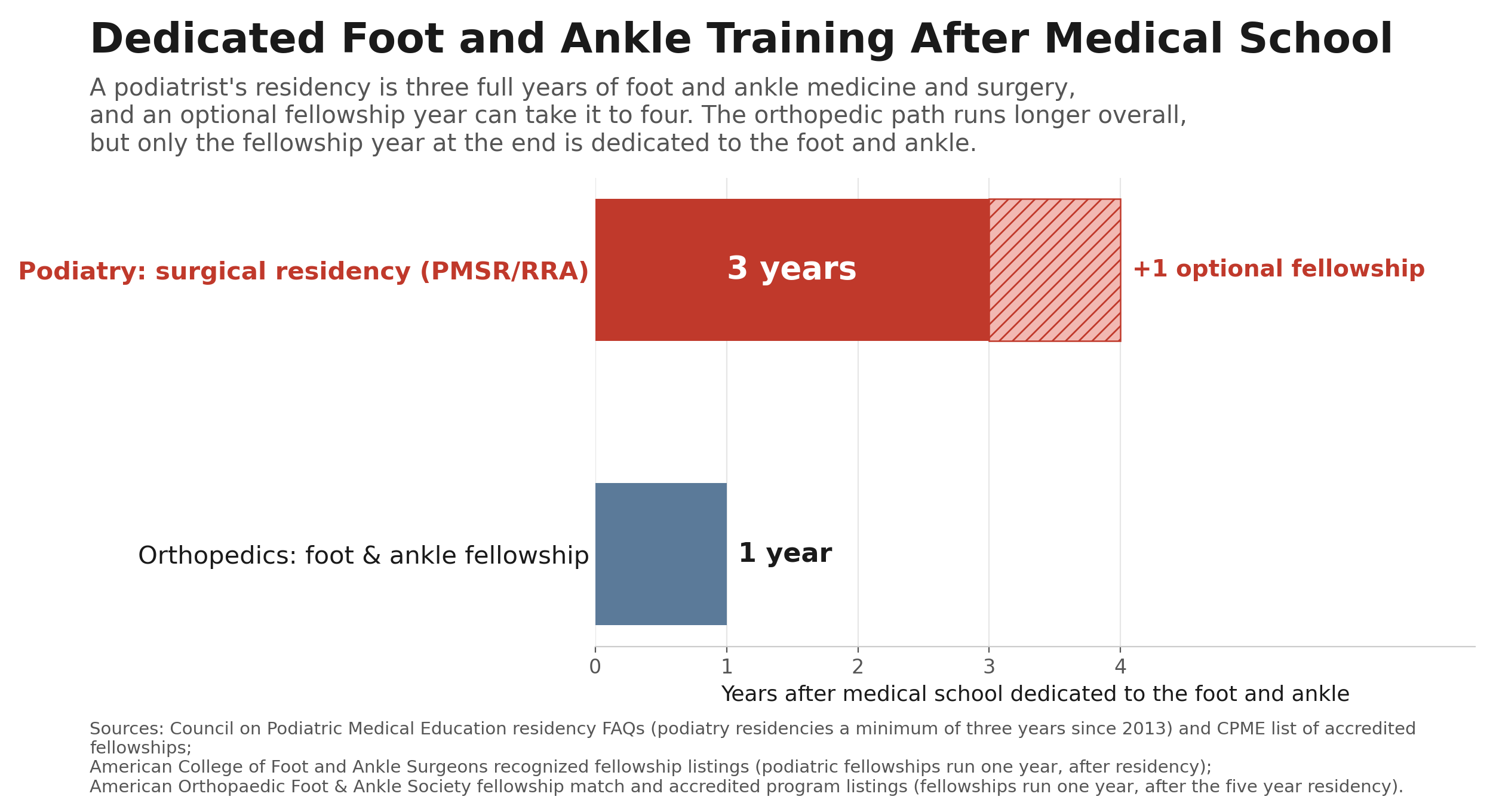
Two paths into foot and ankle surgery. The podiatry path dedicates the three residency years, with an optional fellowship year on top. The orthopedic path dedicates a fellowship year after residency.1,2,3
Board certification follows residency. It comes through the American Board of Foot and Ankle Surgery and the American Board of Podiatric Medicine. Those are the two certifying boards recognized by the profession's accrediting council.1 Podiatrists are licensed in each state and hold hospital privileges. They prescribe drugs and operate in hospitals and surgery centers.4
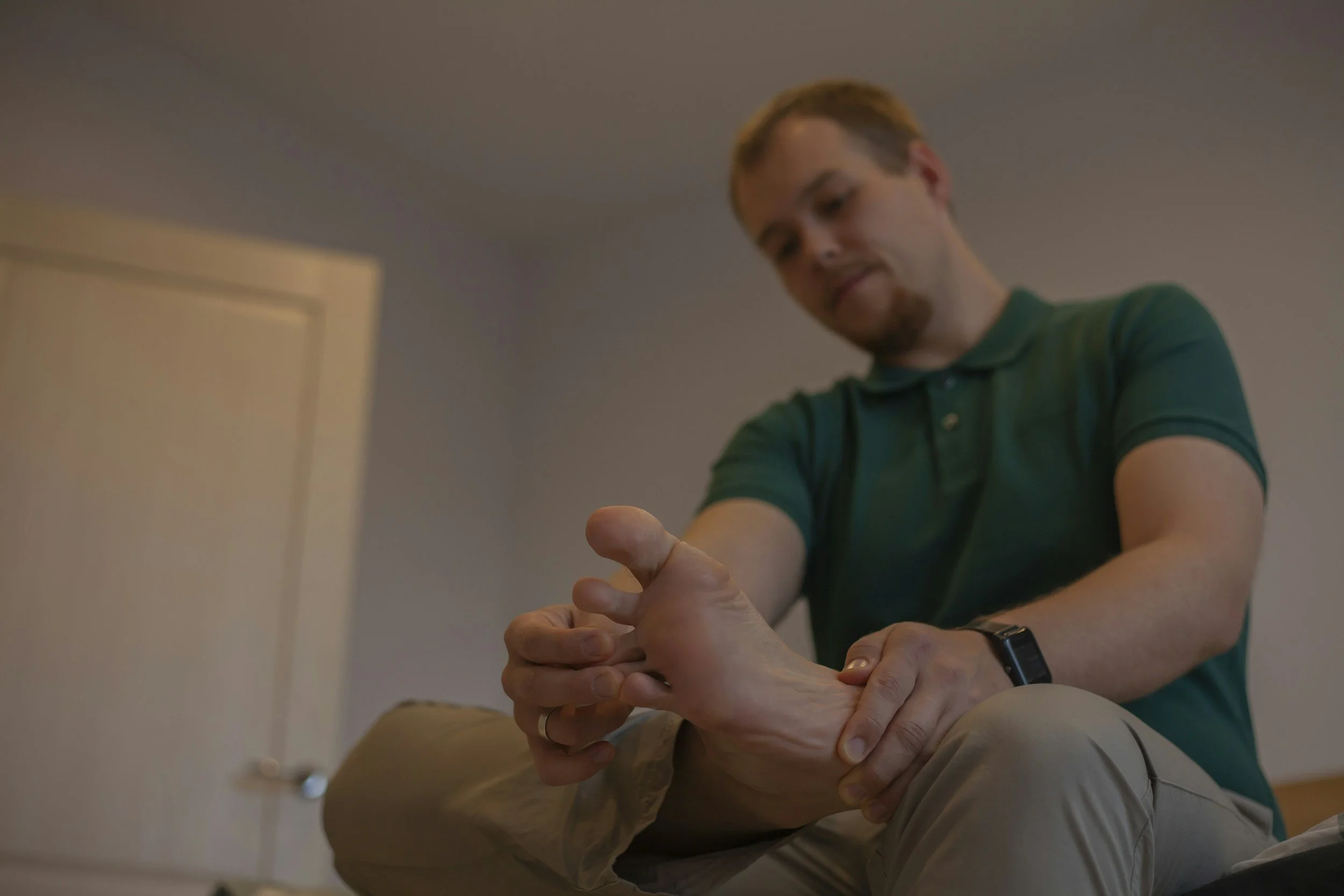
A foot and ankle exam covers the whole lower leg, not just the spot that hurts.
What a podiatrist treats
Some of the work is everyday. Bunions. Heel pain. Ingrown toenails. Sprains and fractures. Arthritis. Sports injuries. Flat feet and tendon problems. If it involves the foot or ankle, it lands here first.
Some of the work is as serious as medicine gets. More than 40 million Americans live with diabetes.5 Between 19% and 34% of people with diabetes will get a foot ulcer in their lifetime.6 Those ulcers are where infections, hospital stays, and amputations start, and preventing that slide is core podiatry work. The landmark New England Journal of Medicine review on diabetic foot ulcers was led by a podiatrist.6 Limb salvage teams exist because feet and legs can be saved, and podiatrists sit at the center of those teams.
The stakes are not abstract. Five years after a major amputation, 56.6% of patients have died. All cancers pooled kill 31.0% over the same five years.7 A major amputation carries a higher five year mortality than cancers overall. Saving the leg is survival work, and it is the center of this profession.
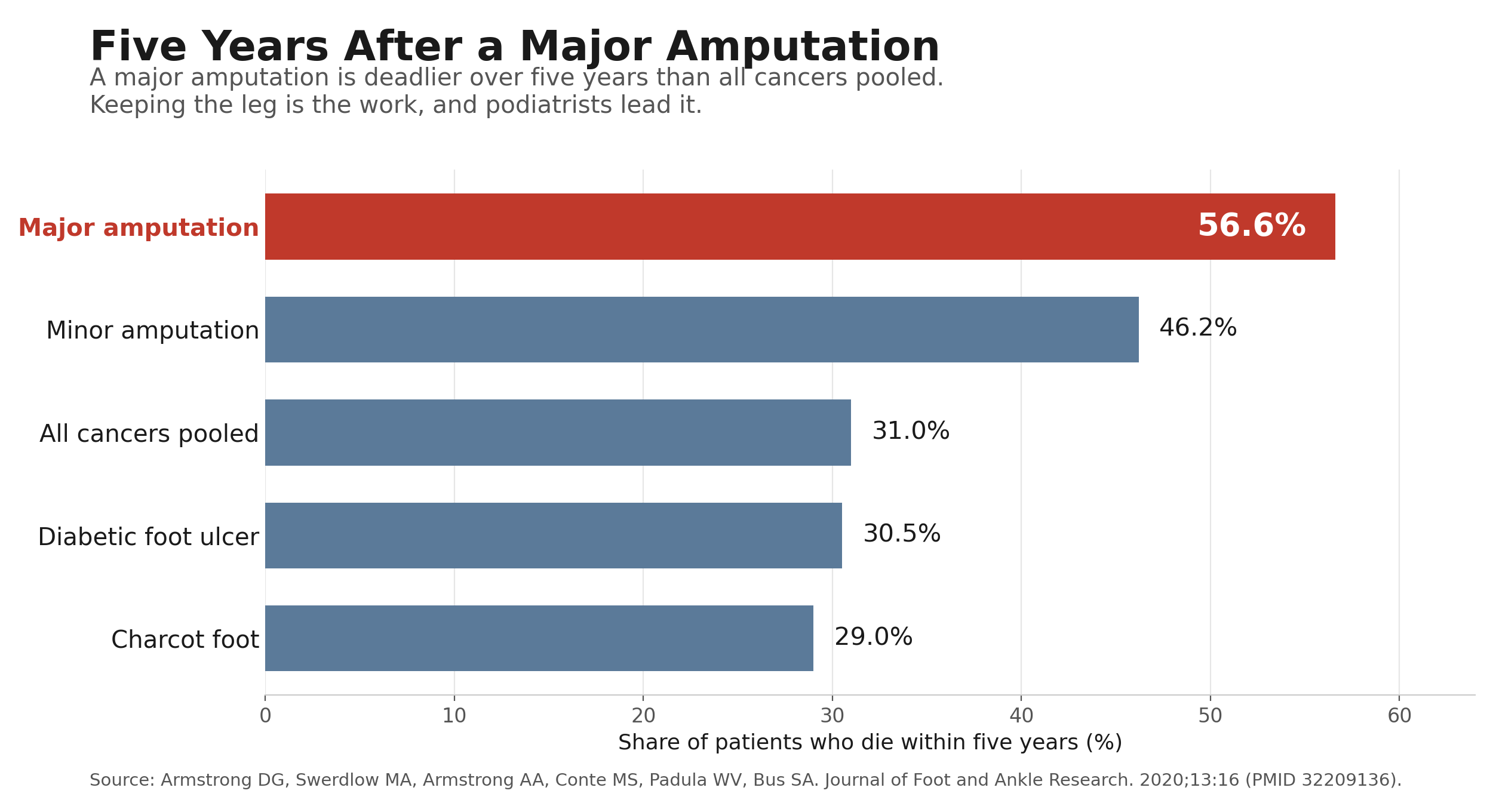
Five year mortality after major amputation is higher than five year mortality for cancers overall. This is the case for limb salvage.7
When podiatry is on the team, legs get saved
This is not a claim. It is a published record. Study after study, when podiatrists are part of the care, fewer legs come off and care costs less.
| What was studied | What happened |
|---|---|
| Care teams that include a podiatrist, meta analysis of 12 studies | Major amputations cut 55%. Total amputations cut 31%.8 |
| Full podiatry integration at Michigan Medicine | Major amputations fell from 127 a year to 85 a year, and the major amputation rate was cut in half.9 |
| Podiatry care before a foot ulcer appears | Amputation risk dropped to between 31% and 77% of the risk seen with other care pathways.10 |
| Podiatry care in the year before an ulcer, costs followed for two years | Care cost $13,474 less per commercially insured patient.11 |
| A hospital limb salvage program grows from one podiatrist to four | Clinic volume rose 60% and operating room volume rose more than 40%. Podiatry generated 40% of the program's physician work value with the same number of surgeons, and the vascular surgeons' own volume still rose more than 10%.12 |
And the need is still wide open. Among the highest risk patients with diabetes, people on dialysis or living with a prior ulcer or amputation, only 30% had any preventive podiatry care at all.13 Seven in ten of the patients who need this care most never got it. That gap is the chance, for patients and for the field.
The surgery, and who does it
Surgery in this field covers the full foot and ankle. Bunion correction. Fracture repair. Tendon and ligament surgery. Joint surgery for arthritis. Surgery to rebuild the foot for deformity and for Charcot, the joint collapse that diabetes can cause. In my own practice, the focus is minimally invasive foot and ankle surgery, Charcot reconstruction, and diabetic limb salvage. I also founded the first employed podiatry service line at my health system, so this care had a permanent home instead of a referral out the door.
The volume backs the training. Podiatrists do almost nine of every ten bunion corrections in the United States.14 Total ankle replacement is the most complex elective surgery in the ankle. On that surgery, patient outcomes match across surgeon specialties.15 This is the specialty that does this work, at scale, every day.
| The number | What it means |
|---|---|
| Almost 9 of 10 | Bunion corrections in the United States are performed by podiatrists.14 |
| No difference | Total ankle replacement outcomes, revision, readmission, infection, and blood clots, match across surgeon specialties in 13,514 cases.15 |
| About 18,000 | Podiatrists practice in the United States, licensed in every state.16 |
| 40.1 million | Americans live with diabetes, the engine of foot and ankle demand.5 |
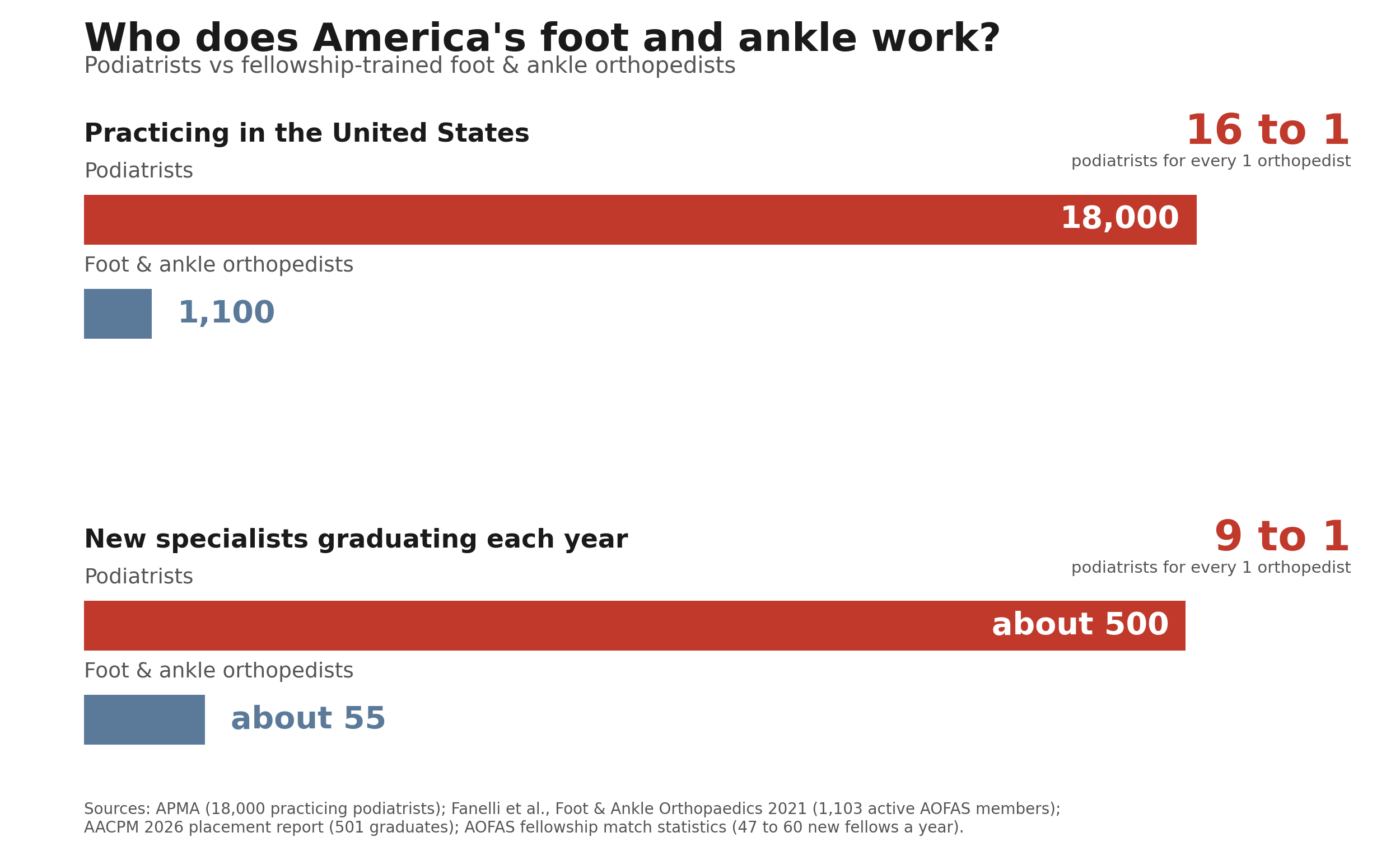
The workforce behind that scale. About 18,000 podiatrists practice in the United States, against about 1,100 fellowship-trained foot and ankle orthopedists, and about 500 new podiatrists finish training each year against about 55.
📖 Your Complete Guide to Diabetic Foot Care — Day to day diabetic foot care, and the habits that keep small problems small.
📖 Bunions: What Helps, When to Consider Surgery, and What Recovery Is Really Like — The full picture on bunions, from shoe changes to modern minimally invasive surgery.
📖 Becoming a Podiatrist: Training, Pay, and How to Apply — Reading this as a student, or for someone you love who is thinking about medicine? The companion piece makes the case for the career itself, the training path, the pay, the AI numbers, and how to apply.
Frequently Asked Questions
Is a podiatrist a real medical doctor?
Yes. A podiatrist holds a Doctor of Podiatric Medicine degree earned over four years of medical school. A three year hospital residency and a state license follow. Podiatrists diagnose illness and injury, prescribe drugs, and operate, all within the foot, ankle, and lower leg.
What is the difference between a podiatrist and an orthopedic surgeon?
Both are surgeons who treat the foot and ankle, and they arrive by different paths. An orthopedic surgeon does medical school and a five year residency across the whole skeleton. Often a fellowship in one subspecialty follows, which can be the foot and ankle. A podiatrist does podiatric medical school, which covers the core medical sciences and then focuses on the foot and ankle. A three year podiatry residency follows. The two work side by side, and many hospitals and practices include both.
Can a podiatrist perform surgery?
Yes. Surgery is built into the training from the start. Podiatry residency is hospital based surgical training, and board certified podiatric surgeons operate in hospitals and surgery centers. The range runs from bunion correction and fracture repair to surgery for severe deformity and limb salvage work that keeps people walking.
I have diabetes. Why does my doctor keep asking about my feet?
Diabetes damages nerves and blood flow, and the feet are where that damage shows up first and worst. Between 19% and 34% of people with diabetes will get a foot ulcer in their lifetime.6 Routine podiatry visits catch problems while they are small, and small problems are the kind that heal. Care teams that include a podiatrist cut major amputations by 55% across the published studies.8 That is how ulcers get prevented and legs get saved.
How long does it take to become a podiatrist?
Seven years after college. Four years of podiatric medical school earn the DPM degree. School covers the core medical sciences first, then focuses on the foot and ankle. A three year podiatry residency follows, built around the foot and ankle. That total matches the training time for internal medicine, family medicine, and pediatrics.
References
- Council on Podiatric Medical Education. FAQs, Residency Programs. cpme.org. All CPME approved residency programs a minimum of three years since 2013; ABFAS and ABPM are the CPME recognized certifying boards.
- American Orthopaedic Foot & Ankle Society. Orthopaedic Foot & Ankle Fellowship Match and accredited fellowship program listings. aofas.org. Fellowships run one year, August 1 to July 31, and follow a completed orthopaedic surgery residency. AOFAS accredited programs at Cleveland Clinic, Washington University, the University of Virginia, and the Medical College of Wisconsin each list the fellowship at one year. Orthopaedic surgery residency is five years (60 months) of ACGME accredited training spread across all orthopaedic subspecialties, per the American Board of Orthopaedic Surgery.
- Council on Podiatric Medical Education. List of Accredited Fellowships. cpme.org. CPME accredited podiatric fellowships, taken after residency, include limb preservation, reconstructive foot and ankle surgery, diabetic limb salvage and wound care, complex deformity correction and limb reconstruction, and research programs. American College of Foot and Ankle Surgeons. Recognized fellowship program listings. acfas.org. ACFAS recognized fellowships in reconstructive rearfoot and ankle surgery, deformity correction, and reconstruction and limb salvage each list a duration of one year and follow a completed podiatric residency.
- U.S. Bureau of Labor Statistics. Occupational Outlook Handbook, Podiatrists. bls.gov/ooh/healthcare/podiatrists.htm. DPM education and 3 year residency; demand driven by the aging population and rising diabetes and obesity.
- Centers for Disease Control and Prevention. National Diabetes Statistics Report. 40.1 million people of all ages with diabetes in the United States, 2023 data.
- Armstrong DG, Boulton AJM, Bus SA. Diabetic Foot Ulcers and Their Recurrence. New England Journal of Medicine. 2017;376(24):2367–2375. DOI 10.1056/NEJMra1615439. PMID 28614678.
- Armstrong DG, Swerdlow MA, Armstrong AA, Conte MS, Padula WV, Bus SA. Five year mortality and direct costs of care for people with diabetic foot complications are comparable to cancer. Journal of Foot and Ankle Research. 2020;13:16. DOI 10.1186/s13047-020-00383-2. PMID 32209136. Five year mortality: Charcot 29.0%, diabetic foot ulcer 30.5%, minor amputation 46.2%, major amputation 56.6%, all cancers pooled 31.0%.
- Blanchette V, Brousseau-Foley M, Cloutier L. Effect of contact with podiatry in a team approach context on diabetic foot ulcer and lower extremity amputation: systematic review and meta-analysis. Journal of Foot and Ankle Research. 2020;13:15. DOI 10.1186/s13047-020-0380-8. Meta analysis of 12 studies. Total amputations RR 0.69 (31% reduction); major amputations RR 0.45 (55% reduction) with podiatry contact in a team approach.
- Schmidt BM, Holmes CM, Ye W, Pop-Busui R. A Tale of Two Eras: Mining Big Data from Electronic Health Records to Determine Limb Salvage Rates with Podiatry. Current Diabetes Reviews. 2019;15(6):497-502. DOI 10.2174/1573399814666181017104818. Full podiatry integration at Michigan Medicine cut major amputations from 127 to 85 per year and halved the major amputation rate.
- Sloan FA, Feinglos MN, Grossman DS. Health Services Research. 2010;45(6 Pt 1). DOI 10.1111/j.1475-6773.2010.01157.x. PMID 20722748. Podiatrist and specialist care before complications, amputation risk 31% (ulceration) to 77% (cellulitis and Charcot) as likely as care from other professionals. Medicare 5% sample, 1991 to 2007.
- Carls GS, Gibson TB, Driver VR, Wrobel JS, Garoufalis MG, et al. Journal of the American Podiatric Medical Association. 2011;101(2):93-115. Patients who saw a podiatric physician before ulcer onset cost $13,474 less (commercial) and $3,624 less (Medicare) over 2 years of follow up, P<.01 data-preserve-html-node="true" for both.
- Patel N, Tan TW, Weinkauf C, Rice AH, Rottman AM, Pappalardo J, Goshima K, Zhou W. Economic value of podiatry service in limb salvage alliance. Journal of Vascular Surgery. 2022;75(1):296-300. DOI 10.1016/j.jvs.2021.07.126. Growing the podiatry team from 1 to 4 raised clinic volume by an additional 60% and operating room volume by more than 40%. Podiatry generated 40% of the program's wRVUs in 2019 with equal surgeon numbers, and the vascular surgeons' own volume and wRVUs still rose more than 10%.
- Lavery LA, Hunt NA, LaFontaine J, Baxter CL, Ndip A, Boulton AJM. Diabetic Foot Prevention: A neglected opportunity in high-risk patients. Diabetes Care. 2010;33(7):1460-1462. Only 30% of the highest risk patients with diabetes received any preventive podiatry care.
- Burton A, Aynardi MC, Aydogan U. Demographic Distribution of Foot and Ankle Surgeries Among Orthopaedic Surgeons and Podiatrists: A 10-Year Database Retrospective Study. Foot & Ankle Specialist. 2021;14(3). DOI 10.1177/1938640020910951. Podiatrists perform almost 9 of 10 hallux valgus (bunion) corrections in the US. MarketScan claims, 2005 to 2014.
- Fleischer AE, Albright RH, Patel K, Santiago H, Hook J, Tower D, Weil L Jr. Risk of revision and other complications in total ankle arthroplasty do not differ by surgeon specialty: Analysis of the PearlDiver healthcare claims database from 2010 to 2023. The Journal of Foot & Ankle Surgery. 2026;65:6.e1-6.e5. Revision risk and 90 day readmission, infection, and clot risk did not differ by surgeon specialty across 13,514 replacements.
- American Podiatric Medical Association. FAQ about Today's Podiatrists. apma.org/patients-and-the-public/faq-about-todays-podiatrists. Approximately 18,000 podiatrists practicing in the United States, licensed in every state.