A board-certified podiatrist’s honest, evidence-based breakdown. No upsell included.
Written By Dr. Dawson November 2026
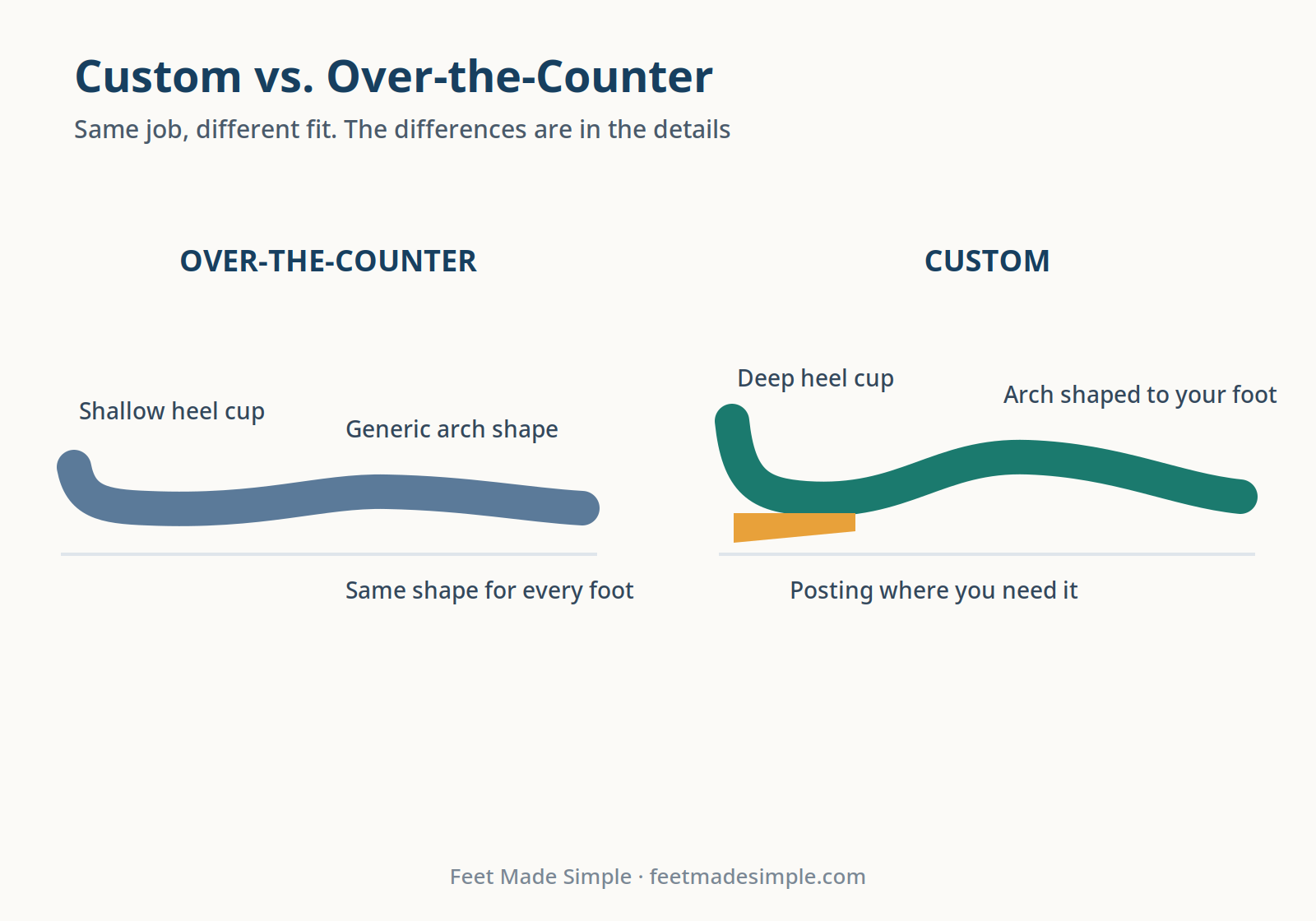
One of these costs ten times more than the other. Whether that's worth it depends entirely on what's wrong with your foot.
Let me be upfront about something: I prescribe custom orthotics. I also tell a significant number of patients they don’t need them, at least not yet and possibly not ever. That’s not a popular thing to say in podiatry, but the research backs it up, and my patients deserve the truth more than they deserve a $500 device they didn’t need.
The orthotics market is enormous, the misinformation is proportionally enormous, and patients are stuck in the middle trying to figure out whether the $25 insert at the drugstore is a waste of money or whether the $600 custom pair from their doctor is a worthwhile investment. The honest answer is that it depends. The good news is that what it depends on has been studied, and this guide walks through all of it, including a few places where the research is less flattering to orthotics than my profession tends to admit.
What Exactly Is an Orthotic? (And What It’s Not)
An orthotic, properly called a foot orthosis, is a device placed inside the shoe to change how forces travel through the foot and lower leg when you stand, walk, or run. That’s the clinical definition. The popular definition is “the thing your podiatrist makes you buy.” Neither is the whole story.
Orthotics work through two main mechanisms: pressure redistribution (moving load away from painful or overloaded areas) and kinematic correction (changing the motion and alignment of the foot and ankle). Biomechanics research shows these effects are real and measurable, and that they are modest: small shifts in rearfoot motion and loading rather than a dramatic realignment, scaling with how the device is built and posted.¹ How much a given device accomplishes depends almost entirely on its design and the condition it’s treating.
They are not magic arch supports. They are not a cure for structural problems. They will not reverse a bunion or melt away arthritis. What they can do, when matched to the right condition, is reduce pain, take load off irritated tissue, and keep you active while the rest of your treatment does its work.
📌 Quick Note: Orthotics are a treatment tool, not a lifestyle product. The goal is always to resolve the underlying problem, not create a permanent dependency on a device.
OTC vs. Custom Orthotics: The Honest Comparison
This is where most of the controversy lives, so let's look at what the literature shows before making any claims.
Over-the-Counter (OTC) Orthotics
A well-designed OTC orthotic, meaning one with a firm supportive shell rather than just a foam pad, has genuine clinical value. The best evidence is in plantar fasciitis (irritation and degeneration of the thick band of tissue along the bottom of the foot). In one of the most cited trials on the subject, a firm prefabricated orthotic and a custom semi-rigid orthotic performed about the same, and both produced small short-term improvements in function compared to a sham insert.²
The key word there is "well-designed." The $8 foam insert at the checkout counter is not an orthotic. It's a cushion, and there's a meaningful difference. Brands like Powerstep, Superfeet, and Vionic make devices with the structural elements that actually matter: a firm heel cup, a supportive arch platform, and materials that don't collapse after six weeks of daily use (see recommendations below).
Custom Orthotics
Custom orthotics are prescription medical devices made from a three-dimensional capture of your foot. Traditionally that meant a plaster cast or foam box impression, and increasingly it means a 3D digital scan. The device is then fabricated to a prescription your podiatrist writes: arch height, heel cup depth, material stiffness, and posting (angled wedges built into the device to tilt the foot into a better position).
Custom devices earn their price in a narrower set of situations than the marketing suggests: significant structural deformity, a limb length discrepancy (one leg measurably longer than the other), failure of a quality OTC device after 6 to 8 weeks, and conditions like posterior tibial tendon dysfunction,³ where the main tendon supporting the arch is failing and precise control matters. I'll be candid that much of the case for custom devices in these scenarios rests on clinical experience and smaller trials rather than large head-to-head studies. That's the honest state of the field.
They're also significantly more expensive, and that cost difference is only justified when the clinical indication is actually there.
Here's the honest summary:
Types of Orthotics: Rigid, Semi-Rigid, and Accommodative
Not all orthotics are built the same, even within the custom category. The material and construction determine what a device can and can't do.
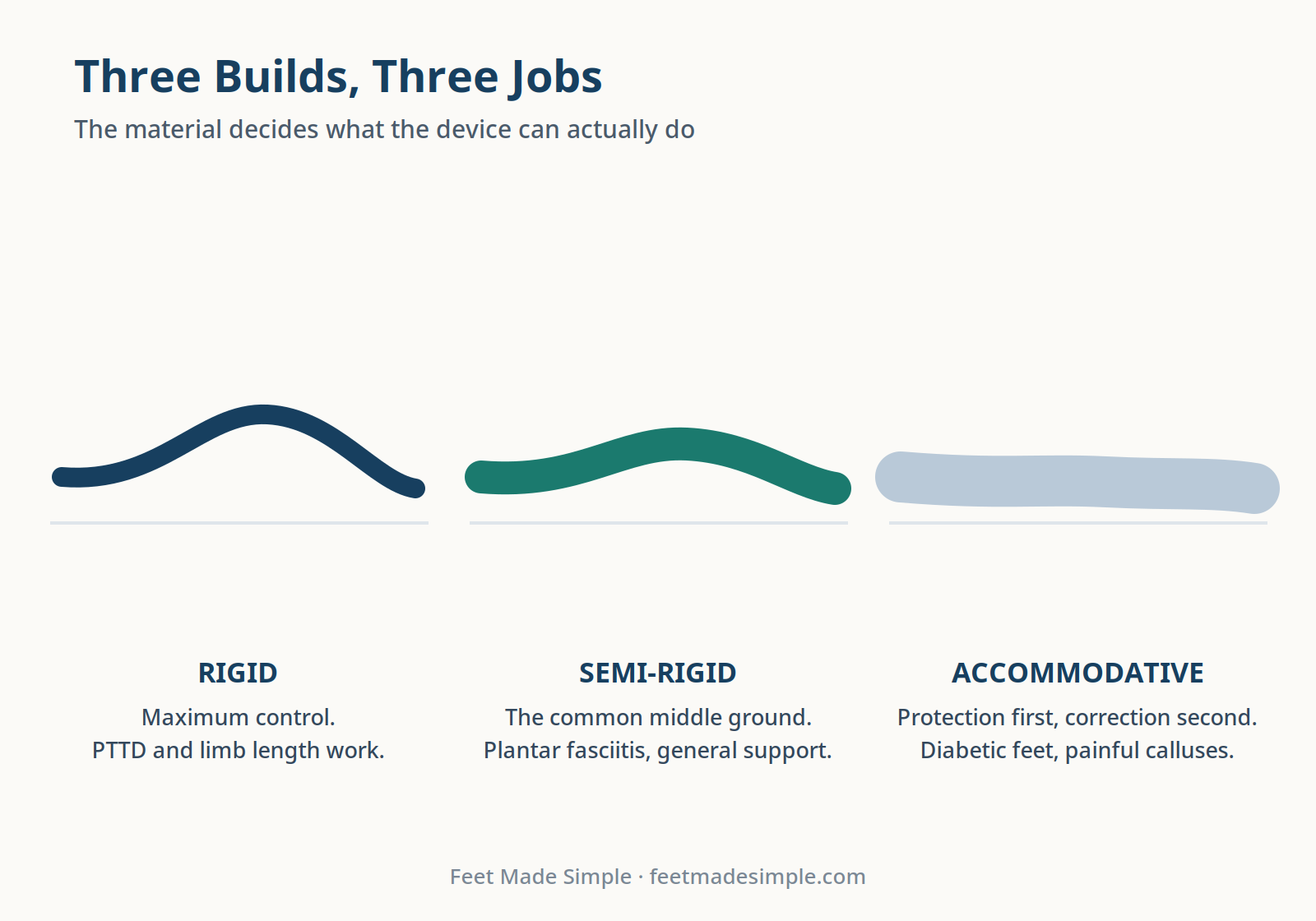
Same job description, very different personalities. The material decides what the device can actually do.
Most patients who need custom orthotics end up with a semi-rigid design. Rigid devices are reserved for cases where precise motion control is the primary goal, such as adult acquired flatfoot. Accommodative devices are essential for patients with diabetes and peripheral neuropathy (nerve damage that dulls sensation in the feet), where protecting fragile tissue takes absolute priority over biomechanical correction.
🔗 Related Reading: Your Complete Guide to Diabetic Foot Care: Protecting Your Feet for Life: Accommodative devices, protective footwear, and the daily foot check routine, covered in detail.
Which Conditions Actually Benefit From Orthotics?
Let's go condition by condition. I'll be direct about where the research is strong and where it's more ambiguous, including a couple of spots where it's less impressive than you'd expect.
Plantar Fasciitis: Moderate Evidence (With an Asterisk)
Plantar fasciitis is the most studied orthotic indication, and the findings are more modest than the orthotics industry would like you to believe. Two systematic reviews published in 2018 in the same journal reached different conclusions. One found moderate-quality evidence that orthotics reduce pain compared to sham inserts at roughly seven to twelve weeks, though the effect was small and its clinical importance uncertain.⁴ The other concluded orthotics were not superior to sham inserts or other conservative treatments.⁵ Both agreed on the point that matters most for your wallet: custom orthotics did not outperform prefabricated ones.
So here's how I use them. Orthotics are one part of a plan built around strengthening, calf and plantar fascia stretching, load management, and supportive footwear. They are not the centerpiece. Start with a quality OTC device, and consider custom only if you're not improving after 6 to 8 weeks and there's a structural reason to think a custom device will do something the OTC one can't.
🔗 Related Reading: Plantar Fasciitis: A Podiatrist’s Guide to Diagnosis & Evidence-Based Management: The full treatment ladder, from stretching and night splints to injections and what comes after.
Overpronation and Flat Feet: Mixed Evidence
Overpronation means the arch collapses inward more than normal as the foot loads. Orthotics reduce strain on the structures that take the brunt of that motion: the plantar fascia, the posterior tibial tendon, and the inside of the ankle. The research here is thinner than most people assume. A systematic review of orthotics for adults with flexible flat feet found no high-level evidence supporting their use, moderate evidence for some improvements in physical function, and only low-level evidence for pain relief.⁶ Orthotics also do not structurally correct flat feet in adults. If your flat feet don't hurt, you very likely don't need orthotics.
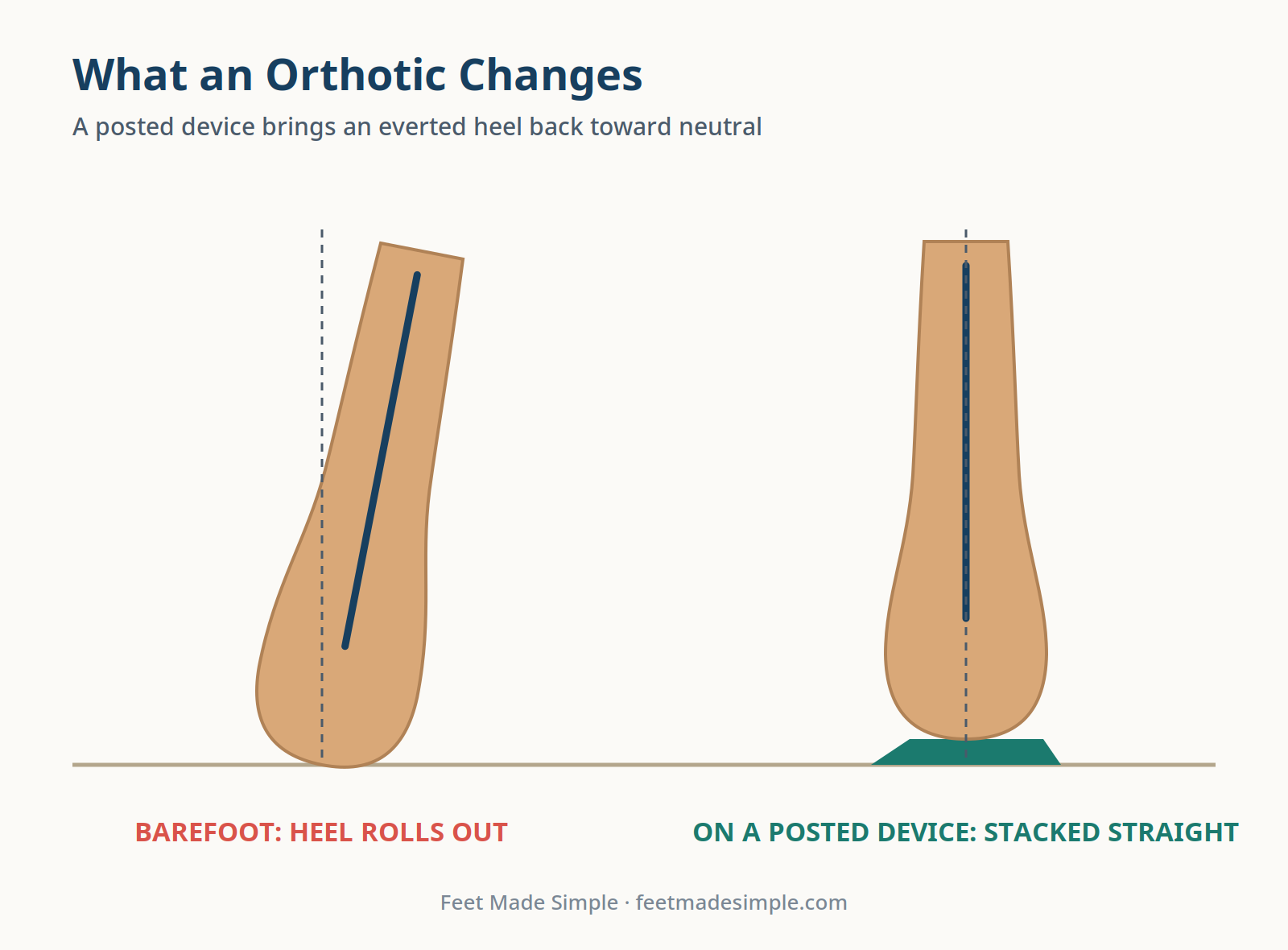
Flat feet are a description, not a diagnosis. They only need treatment when they're causing problems.
Achilles Tendinopathy: Adjunct, Not Primary Treatment
Achilles tendinopathy (degeneration of the Achilles tendon from repetitive overload) is a loading problem, and the treatment is loading. Progressive tendon strengthening, using either eccentric heel drops (lowering the heel slowly under load) or a heavy slow resistance program, has the best evidence, with both approaches producing lasting improvement in a randomized trial.⁷
Where do orthotics fit? A heel lift can make a painful flare more tolerable, and I use them for comfort. But orthotics are an adjunct to a loading program, not a replacement for it. In a well-designed randomized trial of 140 patients doing eccentric exercises, adding custom orthotics produced no meaningful benefit over sham inserts.⁸ The exercise is doing the work.
🔗 Related Reading: Achilles Tendinopathy: Your Complete Guide to Understanding and Healing: Loading progressions, midportion vs. insertional pain, and return-to-run protocols.
Posterior Tibial Tendon Dysfunction (Adult Flatfoot): The Strongest Case for a Structured Device
This is one of the clearest indications for a structured orthotic. In posterior tibial tendon dysfunction (PTTD), the tendon that holds up the arch is gradually failing, and the arch and heel collapse with it. In one prospective study of 47 patients with stage I and II disease, a structured program pairing an orthosis or short ankle brace with targeted strengthening produced successful outcomes in 83% of patients, and 89% said they were satisfied. Only 5 of 47 went on to surgery, and the course was short: a median of 10 therapy visits over a median of 4 months.⁹ A randomized trial found that orthoses plus stretching helped early-stage patients, and adding progressive resistance exercise improved pain and function further.³
In practice, that usually means a rigid or semi-rigid custom device with a deep heel cup that controls hindfoot valgus (the heel tilting outward). OTC devices often aren't enough here, though I'll note that's clinical judgment more than a trial-proven fact.
🔗 Related Reading: Posterior Tibial Tendon Dysfunction (Adult Acquired Flatfoot): When Your Arch Betrays You: Staging, bracing, and when surgery enters the conversation.
Pediatric Flatfoot: Usually Not Needed
Orthotics for children with flexible, painless flat feet are not supported by the evidence. In a randomized trial that followed children for three years, corrective shoes and custom inserts did not change how their arches developed compared to children who received no treatment at all.¹⁰ Most kids grow out of flexible flatfoot on their own. If a child has painful flat feet, activity limitations, or a rigid foot, that's a different conversation, and an in-person evaluation is warranted.
Running Injuries: Moderate Evidence for Prevention
The evidence here is more encouraging than many people realize, at least for prevention. A meta-analysis of eleven trials found that foot orthoses reduced the risk of overall injury by about 28% and stress fractures by about 41%, though they did not prevent soft tissue injuries.¹¹ Two caveats: most of those trials were done in military recruits, and their quality varied widely. The same review found that soft shock-absorbing insoles prevented nothing at all, which is one more reason to stop confusing cushion with support.
🔗 Related Reading: Why Runners Get Hurt (And What to Do About It): Training load errors, footwear, and the most common running injuries, covered in detail.
What Orthotics Can't Do (And Red Flags to Watch For)
Just as important as knowing when orthotics help is knowing when they won't, or when the sales pitch around them is off.
Bunions. A bunion is a structural deformity of the first metatarsophalangeal joint (the big toe joint). An orthotic may ease pain by changing how pressure moves through the forefoot, but it cannot straighten a bunion. Anyone telling you otherwise is either mistaken or selling something.
Morton's neuroma. A Morton's neuroma is a thickened nerve between the toes. A metatarsal pad placed just behind it can meaningfully reduce pain, and that pad can be built into an orthotic, but moderate to severe cases usually need other treatment.
Foam insoles. Cheap foam insoles provide cushion, not biomechanical control. This matters because patients sometimes try the $8 drugstore version, get no relief, and conclude orthotics don't work. They didn't try orthotics. They tried foam.
Kiosk devices. Mall kiosks and some retail stores offer a pressure-mapping scan followed by selection of a pre-made device. That's a fitting process for an OTC insert, not a custom orthotic, which requires a physician assessment and a device fabricated to an individual prescription.
Footwear. A precisely made orthotic in an unsupportive or worn-out shoe delivers a fraction of its intended benefit. Footwear isn't optional. It's part of the treatment.
🔗 Related Reading: Bunions: What Helps, When to Consider Surgery, and What Recovery Is Really Like: What actually helps a bunion, when surgery is worth discussing, and what recovery really involves.
Breaking In Your Orthotics: What to Expect
One of the most common reasons orthotics fail is a bad break-in. Patients put them on, immediately try to walk 10,000 steps, then wonder why their feet hurt more than before.
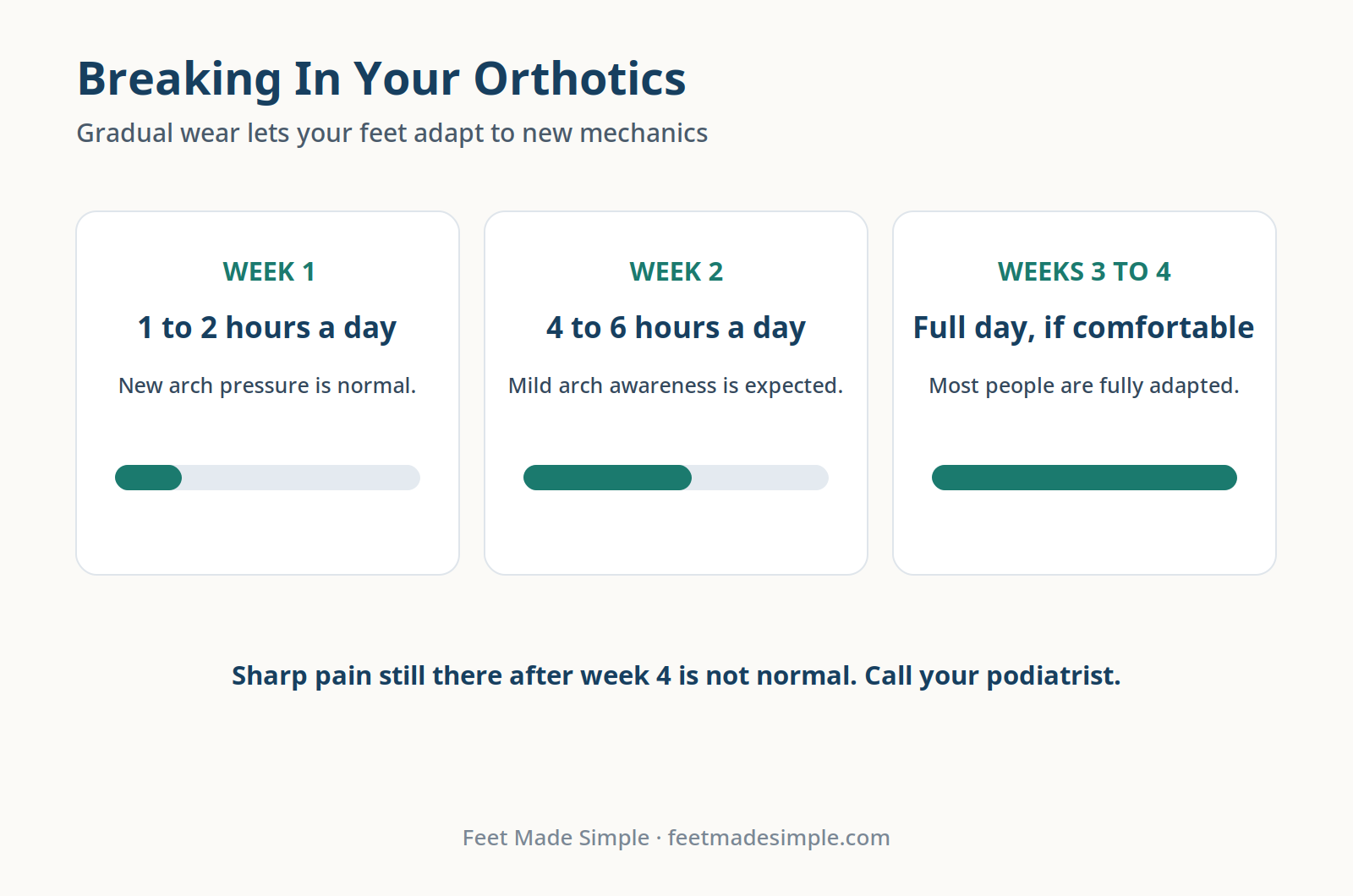
Your feet need time to get used to new architecture. Ten thousand steps on day one is not a break-in, it's a dare.
Here's a reasonable protocol:
- Week one: One to two hours per day. Your foot muscles are adapting to a new mechanical environment.
- Week two: Four to six hours. Mild arch awareness or discomfort is normal.
- Weeks three and four: Progress to full-day wear if comfortable. Most people fully adapt within four weeks.
Persistent, sharp pain in the arch, ball of the foot, or heel after four weeks of gradual break-in is not normal and warrants a follow-up visit. The device may need modification to relieve pressure points or adjust the posting.
⚠️ Important: Custom orthotics are adjustable. If they're still uncomfortable after a proper break-in, tell your podiatrist, because a good lab can grind, re-post, or remake the device.
How Long Do Orthotics Last?
OTC orthotics typically last six to twelve months with daily use, depending on the quality of the shell and how hard you are on them. Replace them when the top cover compresses and the support feels diminished, usually when the device starts feeling like a flat insert instead of a supportive one.
Custom orthotics made from quality materials last considerably longer, typically three to five years for the shell. The top cover may need replacing every one to two years with heavy use. Most podiatrists can refurbish custom devices with a new top cover or new posting rather than fabricating a whole new pair, which cuts the long-term cost significantly.
Children who are still growing should be re-evaluated annually, since foot size and structure change quickly during development.
When to See a Podiatrist About Orthotics
Not every sore foot needs a podiatry visit to get started. A quality OTC device and some patience is a reasonable first step for most common conditions. A professional evaluation is warranted when:
- Symptoms haven't improved after 6 to 8 weeks of consistent OTC orthotic use and appropriate footwear
- Pain is significant enough to limit daily activity or exercise
- You have diabetes, peripheral neuropathy, or circulatory disease, which call for custom accommodative devices and regular foot monitoring
- There's a visible structural deformity (significant flatfoot, a bunion, or a hammertoe, meaning a toe that bends downward at the middle joint) that seems to be progressing
- You've had a foot or ankle injury that hasn't resolved with standard care
- You're returning to high-intensity sport after an injury and need support while you reintroduce load
A good podiatrist won't just hand you orthotics and send you on your way. The device is one part of a plan that should include a footwear assessment, targeted stretching and strengthening, and activity modification where appropriate.
Frequently Asked Questions
Do I have to wear orthotics forever once I start?
Not necessarily. Orthotics manage the load that's causing your symptoms. If the tissue heals and strength improves, many patients can gradually wean off them. Others have structural factors that make long-term use the practical choice. Your podiatrist should talk with you about goals, including the possibility of eventually needing less support.
Can I put my orthotics in any shoe?
It depends on the shoe. Most orthotics work well in athletic shoes and supportive casual shoes with removable insoles. Low-volume shoes (dress shoes, many boots, sandals) often can't accommodate an orthotic without modification. Shoe compatibility should be part of the conversation when your orthotic is prescribed.
Do I need different orthotics for different activities?
Sometimes. A full-length running orthotic may not fit a cycling shoe, and a slim dress shoe device serves a different purpose than a sport device. High-volume runners and athletes often benefit from sport-specific devices. That's a functional consideration, not a sales pitch.
Can orthotics make my feet weaker?
It's a fair question, and the honest answer is that they can contribute to it if you rely on them passively. In one small study, young adults with flat feet who wore custom orthotics for twelve weeks showed measurable shrinkage of several intrinsic foot muscles (the small muscles inside the foot that help support the arch).¹² The fix is to pair the orthotic with strengthening. Another trial found that adding short foot exercises (actively drawing the ball of the foot toward the heel to lift the arch) to orthotic use increased muscle size and toe strength more than orthotics alone.¹³ The orthotic manages your load while you build the strength to eventually need less of it.
Are expensive custom orthotics always better?
No. Price is not a reliable indicator of clinical appropriateness. In plantar fasciitis, the most common reason people buy orthotics, custom devices have not outperformed quality prefabricated ones in head-to-head research.² ⁴ The right device depends on your diagnosis, foot structure, activity level, and footwear, not the invoice.
Recommended Products
These items are listed for education and reference only. They are not a substitute for medical advice. Please see your podiatrist for specific recommendations. I may receive a commission if you purchase through these links, at no additional cost to you.
OTC Orthotics (Best Starting Points)
- Powerstep Pinnacle Maxx: The most versatile OTC option I recommend. Firm shell and structured heel cup, a good fit for plantar fasciitis, mild overpronation, and general foot fatigue. A firm shell is for feet with full sensation; diabetic feet with nerve damage need soft accommodative devices instead.
- Superfeet Berry (Women's): Similar structure to the high-profile Superfeet line with a lower-volume profile designed for women's footwear.
- Vionic Active: A lower-profile option that fits better in everyday shoes and athletic footwear with less interior volume.
Footwear to Pair With Orthotics
- Brooks Ghost Max 3: Roomy toe box, removable insole, and maximal cushion. One of the better orthotic-friendly running shoes available.
- HOKA Bondi 9: Maximum cushion with rocker geometry. Pairs well with semi-rigid orthotics for higher-impact activity.
- New Balance 1540: Motion control category. Best for patients with significant overpronation who also use an orthotic.
- Topo Ultraventure 4: Wide toe box and a removable insole, which makes room for an orthotic in a trail or everyday shoe.
Foot Strengthening Tools
- Theraband Resistance Bands: For progressive ankle and intrinsic foot strengthening. Cheap, durable, and part of nearly every rehab program worth following.
- Yamuna Foot Wakers: Textured half-domes for intrinsic muscle activation and proprioception (your sense of where your foot is in space). A useful companion to orthotic use.
References
- Telfer S, Abbott M, Steultjens MP, Woodburn J. Dose-response effects of customised foot orthoses on lower limb kinematics and kinetics in pronated foot type. Journal of Biomechanics. 2013;46(9):1489-1495. DOI: 10.1016/j.jbiomech.2013.03.036. PMID: 23631857.
- Landorf KB, Keenan AM, Herbert RD. Effectiveness of foot orthoses to treat plantar fasciitis: a randomized trial. Archives of Internal Medicine. 2006;166(12):1305-1310. DOI: 10.1001/archinte.166.12.1305. PMID: 16801514.
- Kulig K, Reischl SF, Pomrantz AB, Burnfield JM, Mais-Requejo S, Thordarson DB, Smith RW. Nonsurgical management of posterior tibial tendon dysfunction with orthoses and resistive exercise: a randomized controlled trial. Physical Therapy. 2009;89(1):26-37. DOI: 10.2522/ptj.20070242. PMID: 19022863.
- Whittaker GA, Munteanu SE, Menz HB, Tan JM, Rabusin CL, Landorf KB. Foot orthoses for plantar heel pain: a systematic review and meta-analysis. British Journal of Sports Medicine. 2018;52(5):322-328. DOI: 10.1136/bjsports-2016-097355. PMID: 28935689.
- Rasenberg N, Riel H, Rathleff MS, Bierma-Zeinstra SMA, van Middelkoop M. Efficacy of foot orthoses for the treatment of plantar heel pain: a systematic review and meta-analysis. British Journal of Sports Medicine. 2018;52(16):1040-1046. DOI: 10.1136/bjsports-2017-097892. PMID: 29555795.
- Banwell HA, Mackintosh S, Thewlis D. Foot orthoses for adults with flexible pes planus: a systematic review. Journal of Foot and Ankle Research. 2014;7(1):23. DOI: 10.1186/1757-1146-7-23. PMID: 24708560.
- Beyer R, Kongsgaard M, Hougs Kjær B, Øhlenschlæger T, Kjær M, Magnusson SP. Heavy slow resistance versus eccentric training as treatment for Achilles tendinopathy: a randomized controlled trial. The American Journal of Sports Medicine. 2015;43(7):1704-1711. DOI: 10.1177/0363546515584760. PMID: 26018970.
- Munteanu SE, Scott LA, Bonanno DR, Landorf KB, Pizzari T, Cook JL, Menz HB. Effectiveness of customised foot orthoses for Achilles tendinopathy: a randomised controlled trial. British Journal of Sports Medicine. 2015;49(15):989-994. DOI: 10.1136/bjsports-2014-093845. PMID: 25246441.
- Alvarez RG, Marini A, Schmitt C, Saltzman CL. Stage I and II posterior tibial tendon dysfunction treated by a structured nonoperative management protocol: an orthosis and exercise program. Foot & Ankle International. 2006;27(1):2-8. DOI: 10.1177/107110070602700102. PMID: 16442022.
- Wenger DR, Mauldin D, Speck G, Morgan D, Lieber RL. Corrective shoes and inserts as treatment for flexible flatfoot in infants and children. The Journal of Bone and Joint Surgery. American Volume. 1989;71(6):800-810. DOI: 10.2106/00004623-198971060-00002. PMID: 2663868.
- Bonanno DR, Landorf KB, Munteanu SE, Murley GS, Menz HB. Effectiveness of foot orthoses and shock-absorbing insoles for the prevention of injury: a systematic review and meta-analysis. British Journal of Sports Medicine. 2017;51(2):86-96. DOI: 10.1136/bjsports-2016-096671. PMID: 27919918.
- Protopapas K, Perry SD. The effect of a 12-week custom foot orthotic intervention on muscle size and muscle activity of the intrinsic foot muscle of young adults during gait termination. Clinical Biomechanics. 2020;78:105063. DOI: 10.1016/j.clinbiomech.2020.105063. PMID: 32521283.
- Jung DY, Koh EK, Kwon OY. Effect of foot orthoses and short-foot exercise on the cross-sectional area of the abductor hallucis muscle in subjects with pes planus: a randomized controlled trial. Journal of Back and Musculoskeletal Rehabilitation. 2011;24(4):225-231. DOI: 10.3233/BMR-2011-0299. PMID: 22142711.
Dr. Dawson
Hi, I’m Dr. Dawson, DPM, FACFAS, DABFAS, DABPM, a double board-certified foot and ankle surgeon. I spend most of my week in clinic and the operating room, and a surprising amount of the rest explaining why the $8 foam insert at the drugstore is not an orthotic or why a viral trend didn’t do what they hyped it to. I started Feet Made Simple™ because patients deserve foot and ankle information built on peer-reviewed research, not product hype. Every post is written by me, fully referenced, and honest about where the evidence is strong and where it isn’t. Biomechanics nerd at heart. Based in Charlotte, NC.